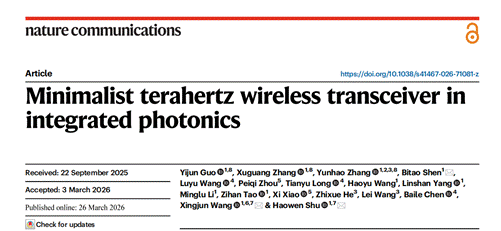
Recently, the research team led by Professor Xingjun Wang and Researcher Haowen Shu published a research article entitled “Minimalist terahertz wireless transceiver in integrated photonics” in Nature Communications. The work addresses a long-standing trade-off in photonics-assisted wireless communication between source purity and digital signal processing (DSP) complexity. By introducing a minimalist hardware architecture, the team demonstrated high-speed terahertz wireless transmission and provided a promising solution for lightweight, low-cost, and massively deployable high-performance wireless transceivers in future end devices.
With the rapid development of the Artificial Intelligence of Things (AIoT), next-generation wireless networks are expected to support high-speed, energy-efficient, and densely deployed data transmission. Terahertz communication, with its ultra-large transmission capacity, is regarded as a key technology for meeting these demands. Photonics-assisted terahertz wireless communication offers intrinsic advantages in broad bandwidth and flexible frequency generation, making it an important route to overcoming the bandwidth limitations of conventional electronics. Although radio-over-fiber and other photonics-assisted wireless schemes have been widely studied and applied in base-station scenarios, their deployment in space-constrained and power-sensitive end devices remains highly challenging.
The main challenges arise from three aspects. First, low-noise high-frequency carrier generation at the transmitter typically relies on narrow linewidth lasers, which are costly, bulky, and structurally complex. Second, high-speed and high-fidelity signal demodulation at the receiver often requires complex coherent receiver architectures, including optical hybrids, balanced photodetectors, and strict optical-path matching. Third, the DSP required for high-speed transmission, especially frequency offset estimation (FOE) and carrier phase estimation (CPE), significantly increases system power consumption, hardware cost, and latency. Meanwhile, using ultra-high-purity coherent sources to simplify DSP requires sophisticated fabrication and precise environmental control, making such approaches difficult to scale for terminal devices. As a result, the inherent trade-off between source purity and DSP complexity has become a key bottleneck for compact photonics-assisted terahertz wireless systems.
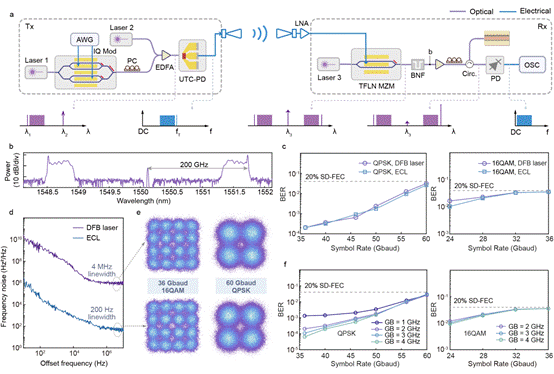
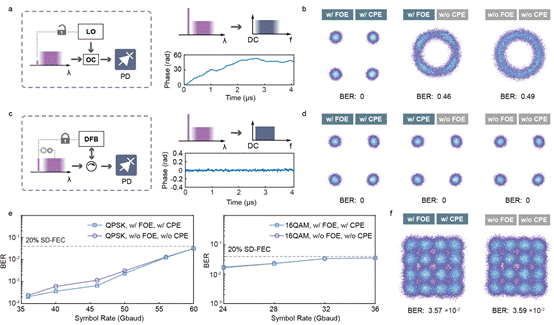
To overcome this bottleneck, the team proposed a coherent phase-locking mechanism based on residual carrier modulation and injection locking. At the transmitter, residual carrier single-sideband modulation ensures that the residual carrier and the signal sideband originate from the same laser and propagate along the same optical path, allowing them to share the same phase fluctuations. At the receiver, injection locking is used to amplify the residual carrier while preserving its phase coherence with the signal sideband. This enables effective cancellation of laser phase noise and channel-induced phase fluctuations at the physical layer, with a measured phase error below 0.1 rad. As a result, the system no longer relies on narrow-linewidth optical sources or coherent-related DSP for carrier recovery, substantially simplifying the transceiver architecture.
At the system-integration level, the work combines high-performance modified uni-traveling-carrier photodiodes and thin-film lithium niobate Mach–Zehnder modulators to realize ultra-broadband OE and EO conversion. Using a 200 GHz carrier frequency, the team experimentally demonstrated terahertz wireless transmission at a data rate of 144 Gbps. Notably, the system achieved identical BER performance when using commercial 4 MHz-linewidth distributed feedback lasers and 200 Hz-linewidth external-cavity lasers, confirming the laser linewidth independence of the proposed scheme. In addition, the system can remove FOE and CPE algorithms, while maintaining almost the same transmission performance, thereby reducing DSP overhead, system latency, and power consumption.
This work demonstrates high-speed terahertz wireless transmission using 4 MHz-linewidth DFB lasers, representing the most relaxed laser-linewidth requirement reported so far in photonics-assisted high-speed wireless communication. It also achieves a record throughput of 144 Gbps with a single-photodetector receiver. By significantly reducing the hardware complexity and DSP burden of photonics-assisted wireless systems, the proposed minimalist transceiver offers important advances in integration level, cost efficiency, and system simplicity, paving the way toward lightweight and large-scale deployment of high-performance wireless end devices for future ubiquitous access networks.
The co-first authors of the paper are Yijun Guo (PhD candidate, School of Electronics, Peking University), Xuguang Zhang (Postdoctoral Fellow, Peking University), and Yunhao Zhang (PhD candidate, School of Electronics, Peking University). The co-corresponding authors are Researcher Haowen Shu, Professor Xingjun Wang, and Postdoctoral Fellow Bitao Shen from the School of Electronics, Peking University. Major collaborators include Associate Professor Baile Chen, PhD candidate Luyu Wang, and PhD candidate Tianyu Long from the School of Information Science and Technology, ShanghaiTech University. Researcher Lei Wang and Researcher Zhixue He from Peng Cheng Laboratory. Dr. Xi Xiao and Dr. Peiqi Zhou from the National Information Optoelectronics Innovation Center. As well as Haoyu Wang, Linshan Yang, Minglu Li, and Zihan Tao from the School of Electronics, Peking University.
This work is supported by National Natural Science Foundation of China under Grant, Fundamental and Interdisciplinary Disciplines Breakthrough Plan of the Ministry of Education of China, National Key Research and Development Program of China, National Key Laboratory of Infrared Detection Technologies and China National Postdoctoral Program for Innovative Talents.
Article link: https://www.nature.com/articles/s41467-026-71081-z
