Recently, a team led by Professor Wang Xingjun and Researcher Shu Haowen from the Center, in collaboration with Professor Wang Jian’s team from the Wuhan National Laboratory for Optoelectronics at Huazhong University of Science and Technology, published a research paper entitled “Exploiting a centrally powered coherent microcomb for lightweight optical transmission” online in the international academic journal Nature Communications.

Article snapshot
In emerging application scenarios such as artificial intelligence (AI), the Internet of Things (IoT), and low-altitude intelligent systems, data traffic is experiencing exponential growth, and the computing paradigm is undergoing a profound shift from centralized cloud computing to distributed edge computing. On the one hand, complex and dynamic environments require edge nodes (such as base stations, autonomous vehicles, and industrial gateways) to process massive volumes of real-time data. On the other hand, the physical space available at the edge is extremely limited, imposing stringent requirements on the size, power consumption, and level of integration of optical transmission systems.
At the chip scale, the research team demonstrated the trade-off relationship among the optical carrier-to-noise ratio (OCNR), linewidth, and transmission rate, and achieved a single-wavelength transmission capacity of 1 Tbps. Furthermore, by co-integrating on-chip waveform shaping with semiconductor optical amplifiers (SOAs), the team constructed a chip-level parallel carrier generator. This approach enabled an aggregate transmission capacity of 5 Tbps while reducing the system footprint by two orders of magnitude, providing a new technological pathway for next-generation edge-computing optical interconnects that are high-capacity, low-power, and highly miniaturized.
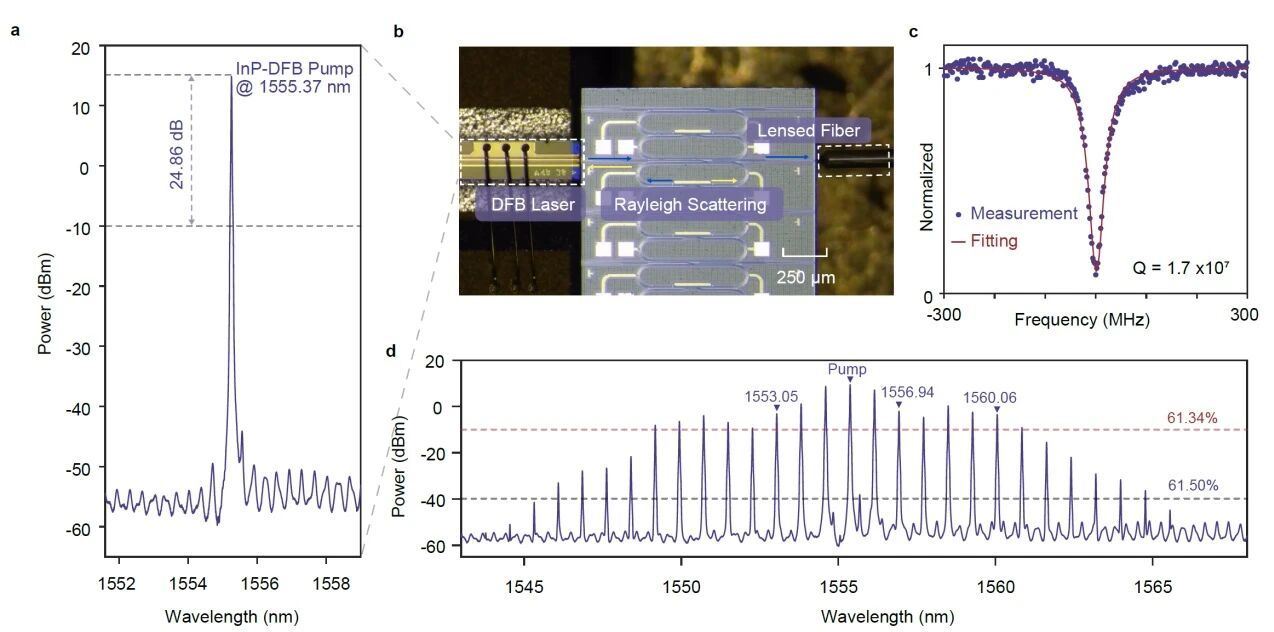

Microcomb Generation and Single-Carrier Lightweight Transmission Demonstration
This work primarily validated the performance of microresonator-based optical frequency combs under standard communication scenarios. In the experiments, the 16 comb lines with the highest intermediate power from a self-injection-locked (SIL) microcomb were selected as carriers for two types of transmission tests.
First, in a 1-km short-reach self-homodyne system, an ultra-high data rate of 110 Gbaud DP-32QAM was achieved on a single channel, yielding a net single-wavelength rate exceeding 1 Tbps.
Second, in a 160-km long-reach homodyne transmission system that more closely resembles practical metropolitan-area network applications, 70 Gbaud DP-16QAM modulation was employed, achieving a total capacity of approximately 8.96 Tbps.
Comparative experimental results show that, compared with a high-performance commercial external-cavity laser (ECL) with a linewidth of approximately 10 kHz, the microcomb—owing to its ultra-narrow linewidth (<600 Hz)—exhibited lower bit-error rates and smaller optical signal-to-noise ratio (OSNR) penalties after long-haul transmission. These results demonstrate its advantages in mitigating fiber nonlinear effects and phase noise.

High-Capacity Transmission Demonstration via Space-Division Multiplexing (SDM)
By introducing the spatial dimension, this study significantly enhanced transmission capacity to emulate traffic aggregation in distributed edge nodes. The core experiment employed a 2-km 24-core multicore fiber (MCF) in combination with 16 wavelengths from the microcomb source, achieving a total transmission rate of up to 215.04 Tbps (net rate of approximately 200 Tbps). This represents the highest reported record to date in the C band using on-chip light sources.
In addition, the experiments demonstrated mode-division multiplexing (MDM) capabilities, including the transmission of LP modes in a 25-km few-mode fiber (FMF) and orbital angular momentum (OAM) modes in a 50-m ring-core fiber (RCF). These results confirm that the microcomb light source is compatible with various types of specialty fibers, and that multi-dimensional multiplexing across wavelength, space, and mode can dramatically expand system capacity without increasing wavelength resources.
Integrated Lightweight Transmission Demonstration
To meet the lightweight requirements of edge computing, a highly miniaturized transmission system was constructed. In this setup, bulky components commonly used in traditional experiments—such as wavelength-selective switches (WSSs) and erbium-doped fiber amplifiers (EDFAs)—were eliminated and replaced by an integrated silicon photonic waveform shaping chip (IWC) and semiconductor optical amplifiers (SOAs).
Although the integrated SOA and IWC introduce higher insertion loss and noise (particularly ASE noise from the SOA) compared with benchtop equipment, the system is able to tolerate these degradations thanks to the exceptionally high coherence and signal-to-noise ratio of the SIL microcomb itself. Ultimately, the chip-level system successfully achieved an aggregate transmission rate of 5.12 Tbps (40 Gbaud DP-16QAM) over 10 km of fiber, while reducing the system’s physical size by approximately two orders of magnitude, thereby validating its feasibility for deployment in compact edge devices.
The paper’s co–first authors are Junhao Han (PhD student, School of Electronics, Peking University), Guofeng Yan and Kang Li (PhD students, Huazhong University of Science and Technology), Bitao Shen (postdoctoral researcher, School of Electronics, Peking University), and Haowen Shu (researcher, School of Electronics, Peking University). The corresponding authors are Researcher Haowen Shu and Professor Xingjun Wang from the School of Electronics, Peking University, and Professor Jian Wang from Huazhong University of Science and Technology. Additional important contributions were made by Yimeng Wang, Yuchen Zhang, Jiong Xiao, Yichen Wu, Huajin Chang (all PhD students at the School of Electronics, Peking University), Chengkun Cai (postdoctoral researcher, Huazhong University of Science and Technology), and Xuguang Zhang (postdoctoral researcher, School of Electronics, Peking University).
This research was supported by the National Key Research and Development Program of China, the National Natural Science Foundation of China, the China Postdoctoral Innovative Talent Support Program, the Natural Science Foundation of Hubei Province, and the Innovation Fund of the Hubei Optics Basic Discipline Research Center, among others.
Article link: https://doi.org/10.1038/s41467-025-67603-w
