On February 18, 2026, the Center published a research article entitled “Integrated photonics enabling ultra-wideband fibre–wireless communication” in Nature. The work was jointly carried out by the team led by Xingjun Wang (Professor) and Haowen Shu (Research Fellow) at the Center, in collaboration with the team of Academician Shaohua Yu from Peng Cheng Laboratory, the group led by Associate Professor Baile Chen at ShanghaiTech University, and the team led by Xi Xiao from the National Information Optoelectronics Innovation Center.
This collaborative effort has achieved a breakthrough in next-generation wireless communications (6G) and optical communications by proposing, for the first time internationally, the concept of integrated fibre–wireless converged communications, enabling seamless cross-network integration between fibre-optic and wireless communication systems.

Paper Screenshot
Leveraging self-developed ultra-broadband optoelectronic integrated chips and AI-enabled advanced equalization algorithms, the demonstrated system supports record-breaking data transmission rates across all major teleco
demonstrated a fully integrated fibre–wireless converged communication system. In fibre-optic transmission, a single-channel 256 Gbaud (512 Gbps) direct-detection link was achieved; in terahertz wireless transmission, a single-channel 400 Gbps photonic wireless link was realized. In addition, a real-time wireless transmission demonstration of 86 parallel 8K ultra-high-definition video streams was completed, with all key performance metrics surpassing previously reported results.
To address the long-standing challenge of unifying architectures for fibre and wireless communications in future ultra-high-speed interconnects, the researchers proposed and validated a new fibre–wireless converged communication scheme. Based on a thin-film lithium niobate integrated photonics platform and an improved UTC-PD structure, the scheme establishes a broadband, flat electro-optic-electro conversion chain, fundamentally avoiding the bandwidth and noise limitations of conventional electronic frequency-multiplication approaches, while providing more than 100 GHz of usable signal bandwidth in both wired and wireless domains.
Furthermore, the team introduced artificial intelligence into digital signal processing and developed a neural-network-based channel equalization algorithm, significantly enhancing system robustness against nonlinear distortions and complex channel conditions, thereby providing reliable algorithmic support for ultra-high-speed transmission.
Experimental results show that the proposed system can serve as a unified physical-layer functional module supporting both fibre-optic and terahertz wireless communications, achieving—for the first time—deep integration of wired and wireless communication capabilities at the physical layer. Additional multi-user scenario demonstrations indicate good channel consistency and scalability under 6G-scale access conditions, highlighting the system’s strong potential for future applications in 6G base stations, wireless data centers, and all-optical interconnection networks.

Figure 1. Conceptual illustration of an integrated-photonics-driven all-optical ultra-wideband telecommunications interconnect system

Figure 2. Key performance characterization of the ultra-wideband electro-optic and opto-electronic integrated photonic chip
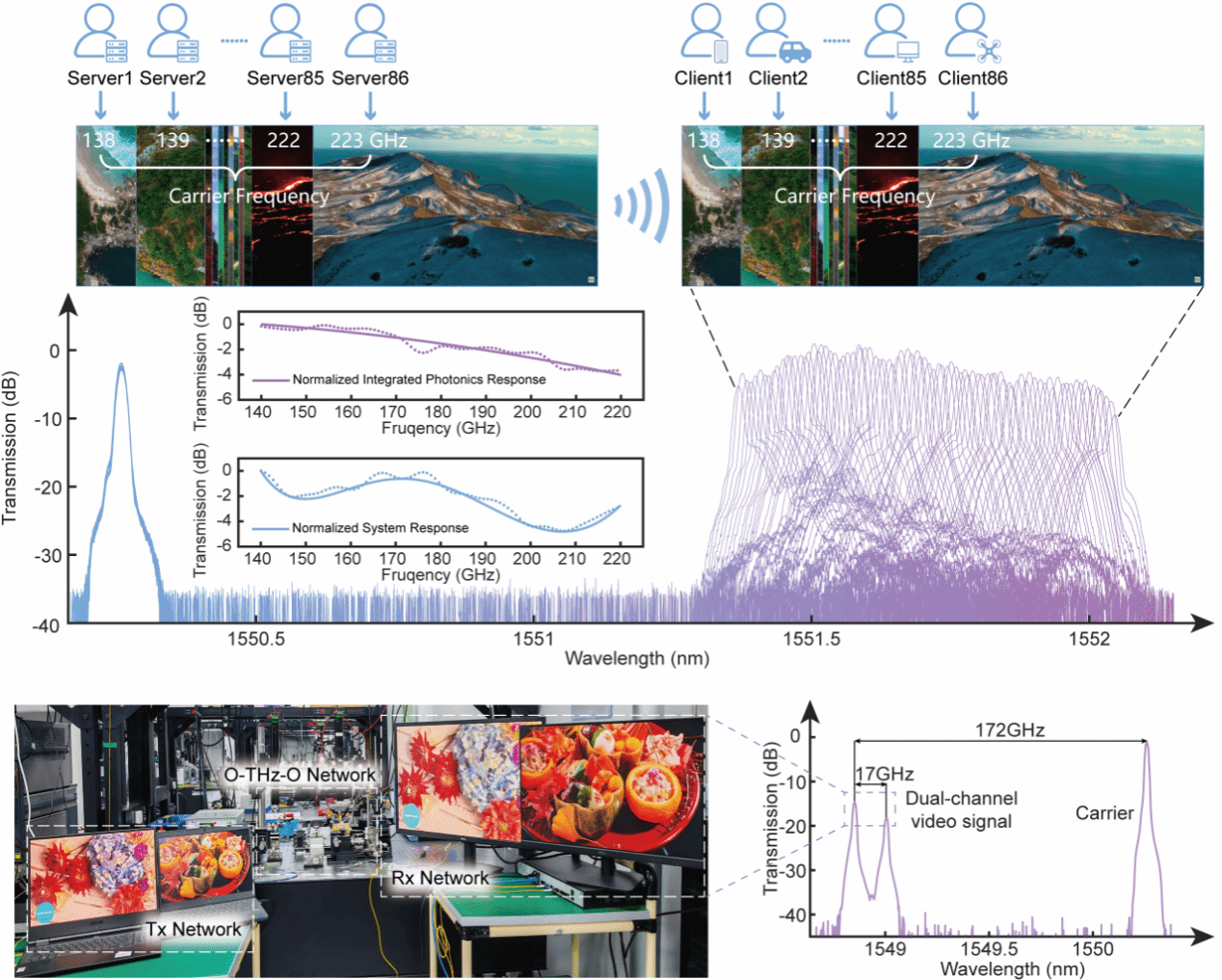
Figure 3. Experimental results of real-time multi-channel high-definition video transmission
Original article link: Integrated photonics enabling ultra-wideband fibre–wireless communication | Nature
